
In today’s digital world, delivering key messaging and media to staff, students, visitors, and guests is a must-have. IPTV systems represent a revolutionary approach to television content delivery, using Internet Protocol networks rather than traditional broadcast methods.
Modern IPTV solutions offer comprehensive management of multiple content types, including live broadcasts, on-demand video, and digital signage. This enables organisations to make informed decisions about implementing systems that can transform their audio-visual communications.
Understanding IPTV technology is crucial for organisations seeking to leverage its benefits. By exploring the technical foundations, key components, and practical applications of IPTV systems, you can determine how to best utilise this technology.
Key Takeaways
- IPTV systems deliver unparalleled management and control of broadcast TV, streaming video, and digital signage.
- Modern IPTV solutions offer comprehensive management of multiple content types.
- Understanding IPTV technology helps organisations make informed decisions.
- IPTV differs from conventional television broadcasting.
- IPTV is becoming the preferred choice for content delivery in various sectors.
Understanding IPTV Systems
IPTV systems are revolutionising the way we consume television content by delivering programmes directly through the internet. This shift offers numerous benefits and changes how users interact with television content.
What Is an IPTV System?
An IPTV system uses internet protocols to deliver television content to users. Unlike traditional broadcasting methods, IPTV sends only the requested content to individual users, enhancing the viewing experience. This personalisation allows for a more tailored approach to television viewing.
IPTV systems integrate multiple services, including television, internet, and telephone, through a single network infrastructure. This integration creates efficiency advantages over separate traditional broadcasting systems.
How IPTV Differs from Traditional TV Broadcasting
Traditional TV broadcasting transmits all channels simultaneously, requiring viewers to tune into their desired channel. In contrast, IPTV delivers only the specific content requested by each user, making it a more efficient and user-centric approach.
- IPTV offers two-way interactivity, enabling features like pause, rewind, and recording of live television.
- Content personalisation is a key differentiator, with IPTV systems capable of delivering tailored recommendations and user-specific interfaces.
- IPTV provides on-demand access to content libraries alongside live channels, offering greater flexibility than traditional TV.
How IPTV Systems Work
At its core, an IPTV system relies on a robust network infrastructure to deliver high-quality video streaming. IPTV technology enables the transmission of television programming over a high-speed internet connection, utilising various types of networks such as Coax, Ethernet, WiFi, and Gpon.
The Technical Infrastructure Behind IPTV
The technical infrastructure behind IPTV involves a complex interplay of hardware and software components. The system requires a sophisticated headend where content is processed and prepared for distribution. This includes encoding video streams into digital formats compatible with IP networks.
The IPTV system uses a combination of technologies to ensure efficient content delivery. This includes content delivery networks (CDNs) and caching mechanisms to reduce latency and improve video quality.
Network Requirements for Optimal Performance
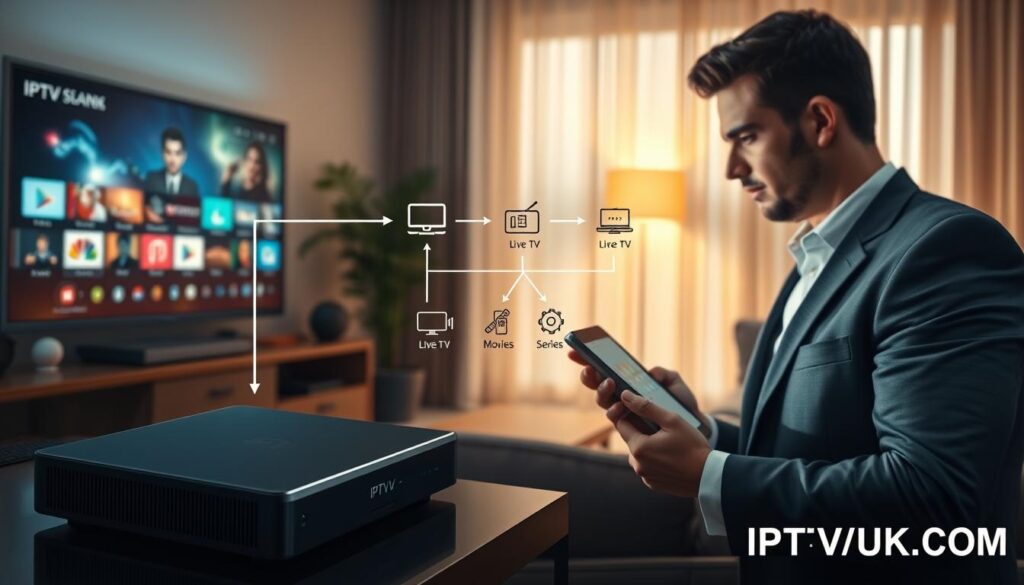
To ensure optimal performance, IPTV systems have specific network requirements. Sufficient bandwidth is crucial, with HD streams typically requiring 5-8 Mbps and 4K content needing 15-25 Mbps per stream.
- Quality of Service (QoS) implementation is essential to prioritise video traffic.
- Network latency should ideally remain below 100ms.
- Multicast support is crucial for efficient delivery of live channels.
- Network infrastructure must be properly designed with appropriate switching and routing capabilities.
By meeting these network requirements, IPTV service providers can ensure a high-quality viewing experience for their users.
Core Components of an IPTV System
To grasp how IPTV systems operate, it’s essential to examine their fundamental components. An IPTV system’s effectiveness relies on the harmonious functioning of its core elements.
Content Sources and Headend Equipment
The IPTV system’s content sources are diverse, including live TV channels, VoD libraries, and encoded sources or streams. Headend equipment plays a crucial role in managing and distributing this content across the network. The headend is where content is received, processed, and prepared for transmission to end-users.
Middleware and Management Software
Middleware acts as the intermediary between the IPTV system’s infrastructure and its applications, enabling the delivery of services such as VoD and EPG. Management software is vital for overseeing the system’s operation, handling tasks like user authentication, content encryption, and billing. This software ensures a seamless user experience by managing the IPTV system’s various components efficiently.
End-User Devices and Set-Top Boxes
End-user devices, particularly set-top boxes (STBs), serve as the primary interface between the IPTV system and television displays. STBs decode IP streams and provide user interface functionality. Modern IPTV deployments also support direct smart TV integration, eliminating the need for separate STBs in compatible environments. For the best viewing experience, selecting the best IPTV set-top boxes is crucial.
Other end-user devices include mobile applications and desktop clients, which extend the IPTV experience to smartphones, tablets, computers, and laptops. These devices often come with additional features like picture-in-picture and multi-screen viewing options, enhancing user engagement. Device management systems allow administrators to remotely configure, update, and troubleshoot end-user equipment across the entire deployment, ensuring a consistent and high-quality service.
Key Features of Modern IPTV Systems
Today’s IPTV systems boast an array of advanced features that transform television viewing. These modern systems are designed to provide a more personalised and flexible viewing experience.
Live Channel Broadcasting
Live channel broadcasting is a fundamental feature of IPTV systems, allowing users to access real-time television programming. This feature is essential for viewers who want to stay up-to-date with live events, news, and sports.
Video-on-Demand Capabilities
Video-on-Demand (VOD) capabilities are a key component of modern IPTV systems, enabling users to access a vast library of content at their convenience. With VOD, viewers can watch their favourite shows, movies, and documentaries whenever they want.
- Access to a vast content library
- Personalised recommendations
- Ability to pause, rewind, and fast-forward content
Digital Signage Integration
Digital signage integration is another important feature of IPTV systems, allowing for the display of targeted advertisements, information, and entertainment in public spaces. This feature is particularly useful in hospitality and corporate environments.
Recording and Content Management
Recording and content management are critical aspects of IPTV systems. With advanced recording capabilities, users can capture live broadcasts for later viewing, and content management tools provide intuitive interfaces for organising and categorising recorded programming.
- Advanced recording capabilities for scheduled, series, and manual recording
- Network-based storage for extensive content archives
- Content management tools for organising and categorising recorded content
- Automated retention policies for managing storage utilisation
- Metadata enrichment for enhanced searchability and discoverability
By incorporating these features, modern IPTV systems offer a comprehensive and engaging viewing experience, making them an attractive solution for various industries and households.
Benefits of Implementing an IPTV System
The benefits of adopting an IPTV system are multifaceted, enhancing both user experience and operational efficiency. By leveraging the existing IP network infrastructure, IPTV systems provide a robust and flexible solution for content delivery.
Enhanced User Experience and Personalisation
An IPTV system offers a significantly enhanced user experience through personalisation. With the ability to customise interfaces, such as seen in ZAFIRO TV, users can enjoy a tailored experience that meets their preferences. This personalisation extends to content recommendations and on-demand services, making it easier for users to find and enjoy their favourite content.
Centralised Content Management
Centralised content management is another key benefit of IPTV systems. Solutions like ZAFIRO TV allow for the management of multiple properties, users, roles, and multimedia content from a single panel. This centralisation facilitates corporate operations and ensures consistency in the guest experience across different locations.
| Feature | Benefit |
|---|---|
| Single Panel Management | Ease of managing multiple properties and content |
| Customisable Interfaces | Personalised user experience |
| Centralised Control | Consistency across locations |
Cost Efficiency and Scalability
IPTV systems are also highly cost-efficient and scalable. By leveraging existing IP network infrastructure, organisations can reduce installation and maintenance costs. Additionally, the scalability inherent in IP-based solutions allows for easy expansion to additional rooms, buildings, or locations without requiring proportional infrastructure investments.

Overall, the benefits of implementing an IPTV system include enhanced user experience, centralised content management, and cost efficiency. These advantages make IPTV systems an attractive solution for various sectors, including hospitality and corporate environments.
IPTV Systems for Hospitality Environments
IPTV systems are revolutionising the hospitality industry by providing guests with personalised entertainment experiences. This transformation is driven by the need for hotels to differentiate themselves and offer unique services that enhance guest satisfaction.
Hotel IPTV Solutions and Guest Experience
Hotel IPTV solutions are designed to elevate the guest experience by offering a range of personalised services. ZAFIRO GUEST is one such solution that provides features like personalisation tags in texts, automatic interface in the customer’s language, and clearing of credentials and browsing history at check-out.
These features ensure that guests have a seamless and enjoyable experience, with content tailored to their preferences.
Integration with Property Management Systems
Seamless integration with Property Management Systems (PMS) is a key benefit of modern IPTV systems. This integration enables automatic provisioning of IPTV services upon guest check-in, with personalised welcome messages and appropriate content access rights.
- Seamless PMS integration enables automatic provisioning of IPTV services upon guest check-in, with personalised welcome messages and appropriate content access rights.
- Billing integration allows guests to purchase premium content or services through the TV interface with charges automatically posted to their room account.
- Express checkout functionality gives guests the convenience of reviewing their bill and completing the checkout process directly through the in-room television.
- Room status updates flow between systems, ensuring housekeeping and maintenance staff have accurate information about room occupancy and guest preferences.
- Guest profile data can be leveraged to personalise the IPTV experience based on loyalty programme status, previous stays, or stated preferences in the PMS.
IPTV for Corporate and Institutional Settings
For corporate and institutional organisations, IPTV systems provide a comprehensive solution for internal communications, training, and public area information display. You can explore more about how IPTV can benefit your business by visiting our page on IPTV for Business.
Internal Communications and Training
IPTV systems enable organisations to streamline their internal communications and training processes. With the ability to broadcast live and pre-recorded content, companies can keep employees informed about company news, policies, and training programmes. This content can be tailored to specific departments or audiences, ensuring that the right information reaches the right people at the right time.
Digital Signage for Public Areas
Digital signage is a crucial aspect of IPTV systems in corporate and institutional settings. It serves multiple functions, including wayfinding, announcements, branding, and ambient information display across various areas. With solutions like ZAFIRO SIGNAGE, organisations can schedule dynamic content, including interactive directories and zoned displays, to maximise the utility of each screen in public areas.
The benefits of digital signage include dynamic content scheduling, emergency notification capabilities, and interactive directories. These features allow organisations to communicate effectively with visitors and employees, enhancing the overall experience within the facility.
Advanced IPTV System Features
Modern IPTV systems have evolved to include a range of advanced features that enhance user experience and provide valuable insights. These features are designed to cater to the diverse needs of users across various settings, including hospitality and corporate environments.
Interactive Services and Applications
Interactive services are a key component of modern IPTV systems, offering users a more engaging experience. These services can include interactive TV applications, allowing users to access a range of services directly through their TV. For instance, you can learn more about the interactive capabilities of modern IPTV systems and how they enhance user engagement.
Multi-Device Support and Mobile Integration
With the proliferation of mobile devices, IPTV systems now often include multi-device support, enabling users to access content across various devices, including smartphones, tablets, and smart TVs. This flexibility is crucial for ensuring a seamless viewing experience. The ZAFIRO CHAIN system, for example, offers centralized corporate management of multiple properties, making it easier to manage content across different devices.
Analytics and User Behaviour Tracking
Advanced IPTV systems also incorporate analytics and user behaviour tracking, providing insights into viewing patterns, popular content, and user engagement metrics. This data is invaluable for content providers, as it helps inform decisions about content acquisition and retention. Some of the key analytics features include:
- Heatmap visualisations to understand navigation patterns through the user interface.
- Content performance metrics to identify the most and least engaging programming.
- Demographic analysis to match content offerings to specific user groups.
- System performance monitoring to track technical metrics like stream quality and device performance.
By leveraging these advanced features, IPTV service providers can significantly enhance the user experience, improve system management, and make data-driven decisions to drive business growth.
Security and Content Protection in IPTV Systems
As IPTV continues to grow in popularity, the need for robust security measures becomes increasingly important. Ensuring the security and integrity of IPTV systems is vital for providers and users alike. A secure IPTV system not only protects content but also safeguards user data and maintains the overall reliability of the service.
Digital Rights Management (DRM) Solutions
DRM solutions play a crucial role in protecting copyrighted content within IPTV systems. By encrypting content and controlling access, DRM ensures that only authorised users can view or download the content. This is particularly important for IPTV providers who distribute premium or copyrighted material.
Network Security Considerations
Securing the network infrastructure is equally important. Key measures include:
- Network segmentation isolates IPTV traffic from other data, enhancing both security and performance while limiting potential attack vectors.
- Access control mechanisms ensure only authorised devices and users can connect to the IPTV system, with authentication required at multiple levels.
- Encryption of management interfaces protects administrative functions from unauthorised access or manipulation.
- Regular security audits and vulnerability assessments identify potential weaknesses before they can be exploited, maintaining system integrity.
- Intrusion detection and prevention systems monitor for suspicious activity, automatically responding to potential security threats in real-time.
For more information on protecting IPTV platforms from cyber threats, visit this resource to learn about common attacks and protection methods.
Cloud-Based vs. On-Premises IPTV Systems
As you evaluate IPTV systems, understanding the differences between cloud-based and on-premises deployments is essential for making an informed decision. The choice between these two models affects not only the initial setup but also the long-term maintenance, scalability, and overall performance of your IPTV service.
Comparing Deployment Options
Cloud-based IPTV systems offer several advantages, including automated and periodic updates, a back-end manager accessible from anywhere, and simple interoperability with other systems. These features contribute to a more sustainable and efficient operation. On the other hand, on-premises solutions provide more control over the infrastructure and potentially better security, as the data is stored locally. For more insights on the comparison between cloud and local solutions, you can refer to this article.
Maintenance and Scalability Considerations
Maintenance requirements differ substantially between deployment models. Cloud solutions typically offer automatic updates and reduced administrative overhead, making them more appealing for businesses looking to minimize IT burdens. In contrast, on-premises deployments require careful hardware lifecycle management, including planned refresh cycles and migration strategies. Scalability is another key consideration, with cloud environments allowing for nearly instantaneous expansion to accommodate growing user bases or additional locations.
Key differences between cloud-based and on-premises IPTV systems include:
- Maintenance requirements differ substantially between deployment models, with cloud solutions typically offering automatic updates and reduced administrative overhead.
- Hardware lifecycle management becomes a significant consideration for on-premises deployments, requiring planned refresh cycles and migration strategies.
- Scalability in cloud environments can be nearly instantaneous, allowing for rapid expansion to accommodate growing user bases or additional locations.
- Bandwidth requirements must be carefully assessed for both models, with on-premises systems needing sufficient internal network capacity and cloud solutions requiring robust internet connectivity.
- Disaster recovery capabilities often favour cloud deployments, which can leverage provider redundancy across multiple geographic regions for enhanced resilience.
Selecting the Right IPTV System for Your Needs
The key to a successful IPTV implementation lies in selecting a system that meets your specific needs. To achieve this, it’s essential to assess your requirements and infrastructure.
Assessment of Requirements and Infrastructure
Before choosing an IPTV system, you must evaluate your current infrastructure and determine its compatibility with various IPTV solutions. For instance, ZAFIRO IPTV adapts to existing coaxial, Ethernet, Wi-Fi, or GPON network infrastructures, making it a viable option for many establishments. You should also consider the technical requirements of the IPTV system and ensure your existing televisions meet these standards.
Key Questions to Ask IPTV Providers
When evaluating IPTV providers, consider the following key factors:
- System architecture and potential bottlenecks
- Content security capabilities and protection for premium content
- Integration capabilities with existing systems, such as Property Management Systems (PMS) and digital signage
- Support and maintenance terms, including response times and update procedures
- Total cost of ownership, including initial purchase, licensing, support, and infrastructure costs
For more information on finding the best IPTV service, you can refer to guides such as The Ultimate Guide to Finding the Best IPTV Service in or visit IPTV UK for specific solutions.
Conclusion: The Future of IPTV Systems
The IPTV landscape is rapidly evolving, driven by technological advancements and changing viewer habits. In today’s digital world, seamless delivery of key messaging and media to staff, students, visitors, and guests is a must-have. As IPTV continues to advance, we can expect to see emerging technologies like AI-driven content recommendations and voice control becoming standard features.
These developments will lead to more sophisticated and personalized viewing experiences. For instance, integration between IPTV and other smart building systems will create unified environments where entertainment, information, and building controls work seamlessly together. To learn more about the future of IPTV and its potential applications, visit our blog post on the future of IPTV with Vodlix.
As traditional broadcasting continues its decline, IPTV systems will increasingly become the primary delivery mechanism for all forms of video content across various environments, including hospitality, corporate, healthcare, and educational settings.